
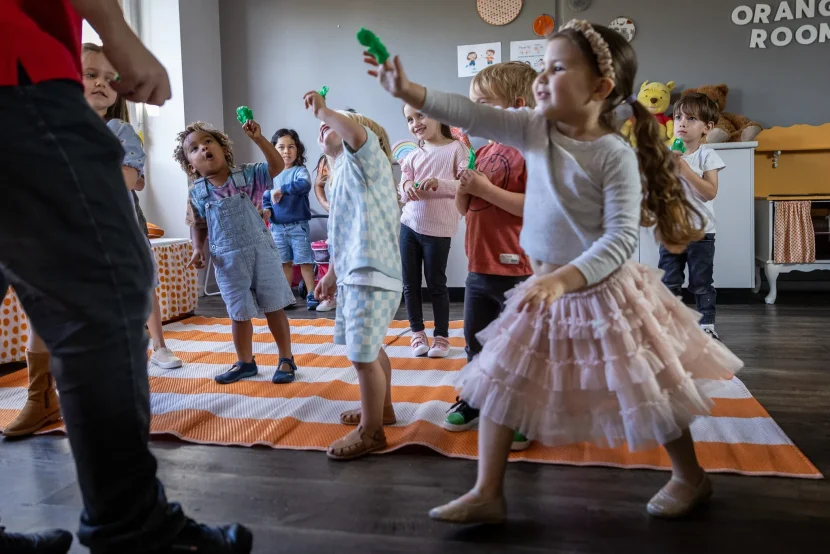
Ever noticed how children instinctively move, clap, or light up when music starts playing? That natural response isn’t just adorable, it’s powerful. Early childhood music classes do far more than entertain; they play a meaningful role in shaping how young brains grow, connect, and thrive.
For parents and early learning centres alike, understanding how music supports development can help guide better choices during those crucial early years. Let’s explore why music isn’t just play, but purposeful learning in action.
The Science Behind Music and Brain Development
During the first five years of life, a child’s brain develops at an extraordinary pace. Neural connections form rapidly, influenced by experiences, the environment, and interactions.
Music is uniquely effective because it activates multiple areas of the brain at once, including those responsible for language, movement, memory, and emotion. Research published in Frontiers in Psychology found that musical training in early childhood is associated with enhanced brain plasticity and improved cognitive skills such as attention and memory.
This means that music and early childhood development are deeply connected. When children engage in rhythm, melody, and movement, they are strengthening the very foundations of learning.
Building Cognitive Skills Through Play-Based Music
One of the most effective ways children learn is through play, and that’s where early childhood music classes shine.
In a well-designed early childhood music program, children are introduced to concepts like beat, rhythm, tempo, and pitch through games, storytelling, and movement. These playful experiences help to:
- Strengthen memory and pattern recognition
- Improve attention and listening skills
- Support problem-solving and sequencing
Hey dee ho use props, puppets, and imaginative play to make learning feel effortless, a reflection of their long-standing expertise in early childhood education.
Supporting Language and Communication Development
Music and language are closely linked. Both rely on rhythm, tone, and pattern, which is why early childhood music development often leads to stronger communication skills.
Singing songs, repeating lyrics, and engaging in call-and-response activities help children:
- Expand vocabulary
- Improve pronunciation
- Develop listening comprehension
Incorporating elements like sign language into music sessions can further enhance communication. Combining visual and auditory cues supports multiple learning pathways, making it especially beneficial for children with diverse learning needs.
This is why music and movement in early childhood education are often used to support early literacy and language development in a fun, inclusive way.
Enhancing Motor Skills and Physical Coordination
Music doesn’t just engage the mind; it gets the body moving too.
Through early childhood music and movement, children develop both fine and gross motor skills. Activities like dancing, jumping, clapping, or using instruments help improve coordination, balance, and spatial awareness.
Structured programs that integrate movement, such as those combining music with yoga or active play, provide even greater developmental benefits.
Boosting Social and Emotional Growth
There’s something special about shared musical experiences. Whether it’s singing together or participating in group activities, music creates connection.
In music and movement early childhood settings, children learn to:
- Take turns and follow instructions
- Express emotions in a safe environment
- Build confidence through participation
For many children, especially those who may struggle with traditional learning environments, music provides a joyful and accessible way to connect with others.
Encouraging Creativity and Imagination
Creativity is a cornerstone of early learning, and music naturally encourages it.
Through role-play, storytelling, and improvisation, children are given the freedom to explore ideas and express themselves. This is particularly evident in early childhood music classes that use themes, costumes, and imaginative play.
When children are encouraged to create, not just follow, they develop confidence in self-expression, flexible thinking and a lifelong love of learning. This playful approach aligns with best practices in early childhood education, where creativity is seen as essential to holistic development.
Why Structured Music Programs Make a Difference
While informal musical play at home is valuable, structured programs offer added benefits.
An experienced early childhood music program is designed with developmental milestones in mind. At hey dee ho, programs incorporate elements like Kodály singing methods, multicultural languages, and spatial awareness to support well-rounded development.
With over 35 years of experience, hey dee ho has refined a play-based approach that consistently engages children while meeting industry standards.
A Strong Foundation for Lifelong Learning
The benefits of music in early childhood don’t stop at preschool. The skills developed through music, from memory and coordination to communication and creativity, carry through into later learning and everyday life.
By introducing children to early childhood music classes, parents and educators are helping to build a strong foundation for:
- Academic readiness
- Social confidence
- Emotional resilience
And perhaps most importantly, a genuine love of learning.
If you’re a parent looking to support your child’s growth, incorporating music into early education is a meaningful step forward. To discover how structured, play-based music experiences can support your child’s development, learn more about our programs.
Get in touch with hey dee ho today.